
mayo 16, 2026• bySuroeste
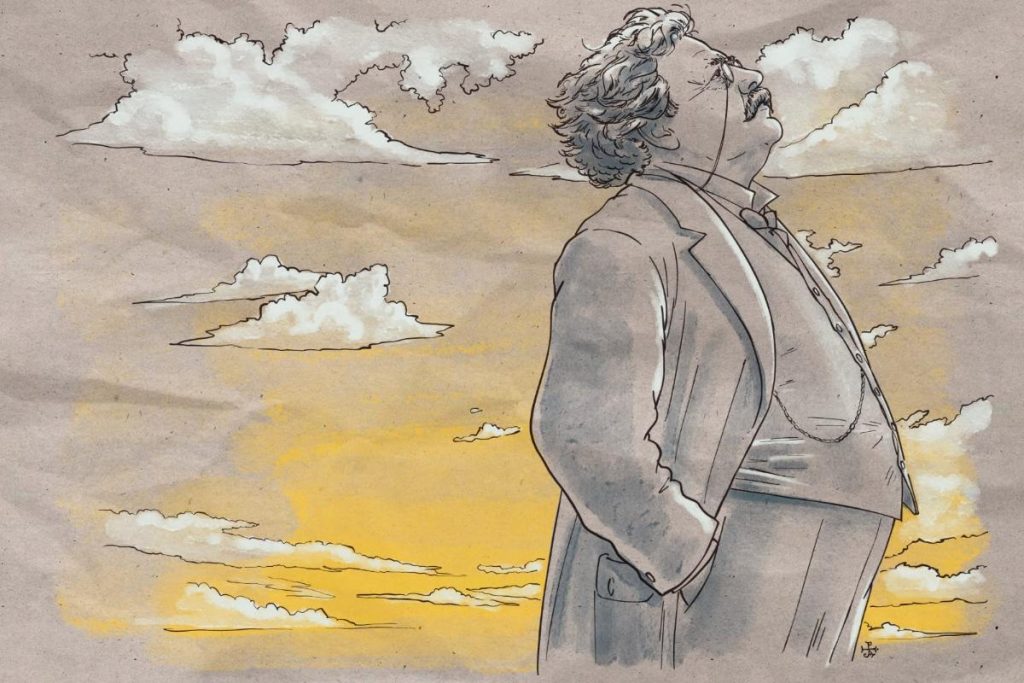
A reflection on the life and work of one of the most influential thinkers of the modern ageRevista Suroeste presents this special edition dedicated to Gilbert Keith Chesterton, marking the ninetieth anniversary of his passing (June 14, 1936). An essayist, polemicist, poet, storyteller, and apologist, he was one of the most lucid and prolific Catholic writers of the twentieth century, capable of examining modern crossroads through an intelligence deeply rooted in common sense, faith, and joy.
In a time marked by moral confusion, the crisis of the home, the idolatry of progress, and the loss of first principles, his work acquires an unexpected relevance. Chesterton did not merely judge his era; he anticipated the crises we face today, standing as a witness who demonstrates that the wounds of the contemporary world stem from the forgetfulness of elementary truths.
This issue seeks to recover some of those cardinal insights: the defense of the family, the sanctity of marriage, the critique of false progress, the unity between truth and love, and the urgency of reclaiming a Christian vision of culture. Far from being relegated to the past, his thought remains an indispensable voice for deciphering our present.
To delve deeper into this legacy, we include essays by Dale Ahlquist and Nancy Carpentier Brown—two of the world’s leading experts on his work, whose texts are presented in both English and Spanish—alongside an article by Álvaro Ferrer, editor of Revista Suroeste and Executive Director of Comunidad y Justicia.
Revista Suroeste
I. “Why Chesterton is Needed Now More Than Ever”
The prophetic wisdom of G.K. Chesterton for a broken and upside-down world.
Dale Ahlquist
Ninety years after the death of Gilbert Keith Chesterton, Dale Ahlquist revisits the striking relevance of an author who seems to have written less for his own time than for ours. Faced with the crisis of the family, education emptied of religion, the false cult of progress, and the separation of truth from love, Chesterton emerges as a voice capable of illuminating the deepest fractures of the present.
For Ahlquist, returning to Chesterton is not a matter of nostalgia, but of recognizing in his work a prophetic lucidity that remains necessary. In a broken and upside-down society, his writings remind us that there is no true progress without a goal, nor authentic freedom when the great laws sustaining human life are broken.
II. “The Marriage of Gilbert and Frances Chesterton”
The Chestertons and the lifelong vocation of married love.
Nancy Carpentier Brown
Nancy Carpentier Brown contemplates Gilbert Keith Chesterton from a decisive dimension of his life: his marriage to Frances Blogg. In the face of a culture that has weakened the sacramental meaning of matrimony and presents the breaking of vows as a form of freedom, the author invites us to look at the union of Gilbert and Frances as an example of fidelity, devotion, and shared vocation.
Infertility, illness, financial hardships, and suffering did not extinguish the joy of their marriage; instead, they made its Christian depth all the more visible. For Brown, the Chestertons demonstrate that marital love is not merely affection or companionship, but a path to salvation, mutual service, and a force capable of healing the life of a wounded society as well.
III. “Waiting on the Threshold of His Own House”
A glimpse into the soul of one who cooperated in the conversion of so many.
Álvaro Ferrer
The potential sanctity of Gilbert Keith Chesterton presents a deeply Chestertonian paradox: the English writer cooperated in the conversion of figures such as C.S. Lewis, Marshall McLuhan, and Dorothy Sayers, yet the Church does not canonize based on results, fame, or apostolic efficacy, but rather on the truth of a life transformed by grace.
Navigating between constant joy, charity toward his adversaries, the fruitfulness of his writings, and the shadows that demand an honest investigation, Álvaro Ferrer proposes an approach to Chesterton free from simplifications. His fruits do not prove sanctity on their own, but they do raise a serious question: what sort of tree could yield such a lasting joy.
Last modified: junio 24, 2026