mayo 16, 2026• byÁlvaro Ferrer


A glimpse into the soul of a man who helped bring so many to conversion
The following warning from C. S. Lewis ought to be printed in red ink on the dust jacket of every Chesterton book: any young man anxious to remain a respectable atheist cannot be too careful of his reading. Lewis spoke from experience, rather as a man points out a patch of ice after having fallen upon it himself. He opened The Everlasting Man as a competent unbeliever and closed it with the distinctly inconvenient suspicion that Christianity was not only comforting, but true.
Nor was he the only casualty. Marshall McLuhan entered the Church in 1937 confessing that, had he not stumbled over Chesterton, he would likely have remained an agnostic for many years. Dorothy Sayers. Dale Ahlquist. A procession of names that no one has quite finished counting. If sanctity were measured by conversion statistics, Chesterton would by now possess an altar of his own—and stained glass besides.
And yet Rome is in no hurry. His cause has not even been formally opened [1]. Here lies the first paradox, and it is a particularly good one. The very thing that would constitute the decisive credential in almost any other profession—the harvest, the results, the conversion of multitudes—is precisely what makes the Church proceed more slowly rather than more quickly. The world canonizes success. The Church, being older and wiser, distrusts it. And she distrusts it for a reason that sounds like a joke and turns out to be a dogma. She learned long ago that a man may set fire to other souls without ever warming his own.
The gift of tongues, as St. Thomas teaches, is given for the benefit of others, not to sanctify the speaker. It belongs to those freely given graces (gratis datae) that pass through a soul as light passes through glass: illuminating, perhaps even dazzling, yet not remaining behind. Caiaphas prophesied without knowing it and without deserving the gift, and no one has proposed his canonization. Nor did Our Lord leave us any excuse for complacency. Having given us the famous rule—“By their fruits ye shall know them”—He immediately stripped away its convenient interpretation. A few verses later He warns that men will come claiming prophecies and miracles performed in His name, only to hear that terrible sentence: “I never knew you.” The same Master who commands us to look at the fruit forbids us, on the very same page, from reading the rule carelessly. For the fruit that reveals a tree is not merely the number of mouths it has fed, but the sort of tree it is.
And here the matter becomes, as Chesterton himself might have said, cheerfully serious. For the important question is not how many people a man converts, but what he converts them into. A merely clever man makes disciples of cleverness. He leaves behind him a trail of bright little sceptics, miniature replicas of his own ingenuity. Chesterton made disciples of gratitude.
Lewis confessed something that no syllogism can adequately explain: he loved Chesterton for his goodness, even while regarding his Christianity as a misfortune. McLuhan did not say that Chesterton had convinced him. He said, in effect, that Chesterton had prevented despair from becoming a habit. That is no longer a victory won. It is a wound healed.
And here one touches the philosophical heart of the matter, though there is no need to become solemn about it. A chain of reasoning can be counterfeited. A man’s joy over forty years cannot. Wit can be imitated. Joy cannot. Joy spreads by contagion, and only those who possess it can pass it on. Wine tastes of the vineyard. Out of the abundance of the heart the mouth speaks. No man overflows with what he does not contain. When the fruit takes the form of charity—when it heals, when it gives hope, when it leaves people more grateful than it found them—the most sober explanation of that shape is that charity was present at the root.
It is not proof. It is flavour. But flavour is a clue that no serious tribunal should ever ignore.
There is, moreover, another clue that mere cleverness cannot counterfeit: constancy. A charisma flickers. A habit burns steadily. Anyone can remain cheerful through an evening of friends and beer. To remain cheerful for forty years against the exhaustion of daily deadlines, debt, illness, and perpetual controversy is no longer a matter of temperament. It is a matter of virtue. And that, precisely, is what the Church means by heroic virtue. Not a single grand gesture dramatically illuminated against the sky, but the repeated practice of the good done readily, easily, and joyfully—whether amid extraordinary trials or the tedious monotony of a Wednesday afternoon. Chesterton’s joy was never a firework reserved for special occasions. It was a stubborn domestic ember. Each morning he lit it again upon a blank sheet of paper. That persistence of happiness is the mark of a habit, not a mood.
There is also the manner of his battles, which may be the least suspicious clue of all. For the gift of words enables a man to refute his neighbour; it does not enable him to love him. Chesterton fought some of the fiercest intellectual duels of his age—against Shaw, against Wells, against half the intelligentsia of London—and emerged from most of them with his opponents transformed into friends. Shaw, his lifelong adversary, he loved almost as a brother. They argued in newspapers and dined together without bitterness. And Wells, the atheist, wrote to him in 1933 that if his own “atheology” should ultimately prove false and his friend’s theology true, he hoped somehow to slip into Heaven simply as Chesterton’s friend. They argued, says the chronicler, but they never quarrelled. That is not the sort of thing supplied by brilliance. To love the man one has just demolished in print is an act, and it has a theological name. Arguments are won one way. The sight of a defeated opponent weeping at one’s funeral is achieved by another virtue altogether.
Then comes scrutiny, which is the longest and cruellest test of all. For sanctity is most often shattered not by weakness but by hypocrisy—by the crack between what a man teaches and what a man is. The argument here proceeds in reverse. It is built from what fails to appear. The biographers have dug. Maisie Ward dug first; later investigators dug deeper still. And the deeper they dug, the more closely the man resembled his own doctrine. The same gratitude. The same humility. The same laughter. No hidden life. No secret cruelty folded away in a drawer. Most idols diminish as one approaches them. Chesterton is among the exceedingly rare few who grow larger. The closer one examines the lamp, the less it flickers.
Almost. For no self-respecting Chestertonian essay can be allowed to powder the face of the dead. Chesterton himself liked gargoyles. He delighted in reminding us that a cathedral is honest enough to carve its demons on the roof, in full view of God and the birds. Let us therefore carve the gargoyle.
The same man who vowed in 1933 that he and Belloc would die defending the last Jew in Europe also repeated, with a stubbornness that remains painful to read, the old canard about wealthy Jews. He managed to insert them even into articles condemning Hitler. Both statements are true. That is the scandal. And it is also the humanity.
We should also remove from the table one fragile defence that some admirers continue to repeat. The supposed “exoneration” by the Wiener Library never existed in quite the form in which it is usually cited, and the institution itself has denied the claim [2]. A candidate for the altars is not honoured by fragile alibis. He is honoured by the truth. Indeed, the truth is the only thing sanctity has ever asked for.
For—and this is what hasty accusers tend to forget—heroic virtue is not the same thing as flawlessness. No saint was ever immune to the prejudices of his own age and place. The Church does not ask whether a man had blemishes. She asks whether he possessed charity habitually, consistently, and to a heroic degree. And that, precisely, is what a cause exists to discover: whether the gargoyle was the face of the building or merely an ugly stone attached to an otherwise spacious and luminous cathedral. Such questions are not answered by shouting across newspaper columns. They are answered by looking slowly.
It is worth, moreover, distinguishing between the two deadbolts that kept the door closed in 2019, for they are not opened by the same key.
Whether there is a sufficiently clear pattern of interior holiness, or whether the shadow of antisemitism weighs too heavily upon the case, are questions about the man himself. Only a patient and honest investigation can settle them.
The other objection—that there is no significant local cult in Beaconsfield—says nothing at all about Chesterton. It says something about us. A cult cannot be decreed. But neither does it descend automatically upon a generation like an inherited defect. It must be kindled. Time may supply what is absent. Pilgrimages may supply it. The prayers of those who owe their faith, in part, to Chesterton may supply it in abundance. What neither time nor pilgrimage nor prayer can manufacture, however, is heroic virtue where none existed in the first place.
Of the two deadbolts, one belongs to God and the other belongs to us. And it is slightly bad manners to complain of a locked door while one’s hand is resting on the key.
What, then, do Chesterton’s fruits achieve for him? Not a halo. An audience. Not a verdict. A hearing. They are smoke enough to justify lighting the lamp of an investigation, though not fire enough to declare the bonfire holy.
And here we arrive at the final paradox, which is perhaps the most delightful of them all.
The fact that the Church has thus far refused to be dazzled by Chesterton’s results is itself the most Chestertonian compliment she could possibly pay him. For he spent his life insisting that what matters is not the conqueror but the child who gives thanks before lighting the firework; not the spectacular effect but the humble root; not success but wonder. By refusing to canonize him on the strength of his achievements, Rome is merely taking its own doctrine seriously. The man who taught us to distrust mere triumph is being measured—thanks be to God—by a Church that distrusts mere triumph. Even his own.
Seen one way, it is the cruellest irony. Seen another, it is the most delicate justice. And Chesterton, who understood that irony and justice are often the same thing viewed respectively from the valley and from the mountaintop, would almost certainly have laughed. Not politely. Not discreetly. But with that enormous laughter of his that made the chairs shake.
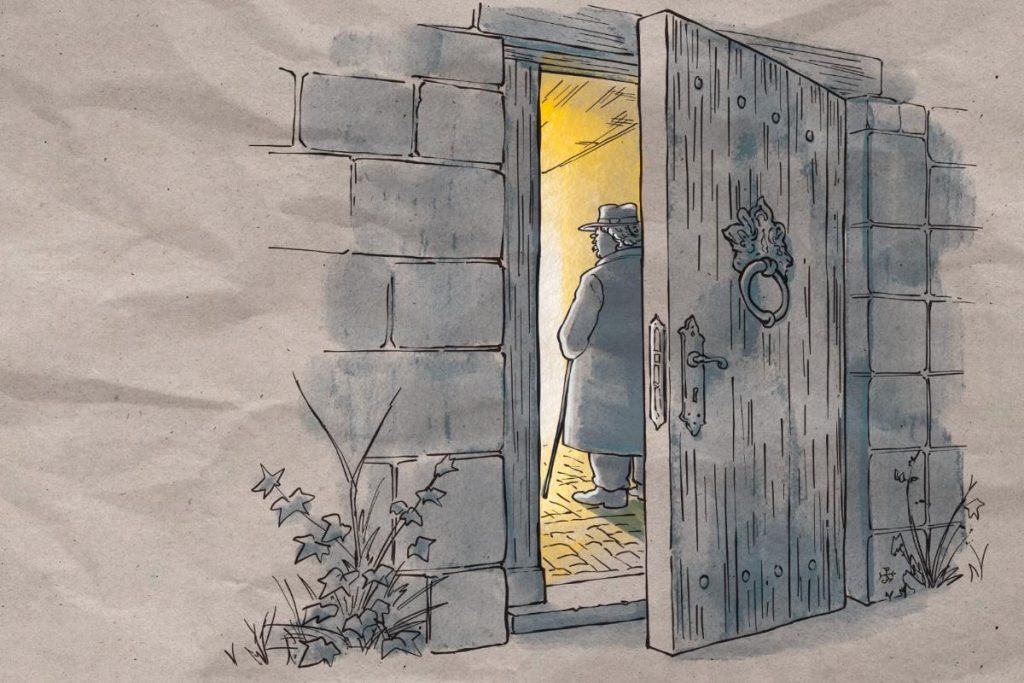
And so a door remains half open. We do not yet know whether the man who led so many others home was himself kneeling upon the threshold when he arrived. I believe he was. But a half-open door is the most hopeful thing in the world, because it possesses exactly the shape of an invitation. And to keep a man waiting at the threshold of his own house—delayed by the very joy he spent a lifetime inviting others to enter—is such a perfectly rounded joke, and such a meaningful one, that it could only have been invented by God. Or, failing that—and by participation in grace—by Chesterton himself.
Editor, Revista Suroeste
Executive Director, Comunidad y Justicia
Notes
[1] The preliminary inquiry commissioned in 2013 by Bishop Peter Doyle (Diocese of Northampton) to Canon John Udris concluded in August 2019 with the decision not to open the cause, citing the absence of a local cult, the difficulty of distilling a pattern of personal spirituality, and the issue of antisemitism. The bishop himself noted that a successor could reopen it.
[2] The attribution of an “exoneration” to the Wiener Library comes from M. Coren, Gilbert: The Man Who Was G. K. Chesterton (1989). The Wiener Library itself has denied having issued such a defense (cf. The Jewish Chronicle, 2013). It is best, therefore, to withdraw it from the argument.


Last modified: junio 23, 2026