17 06 26 matriminio gilbert frances chesterton

by

The Chestertons and the lifelong vocation of married love

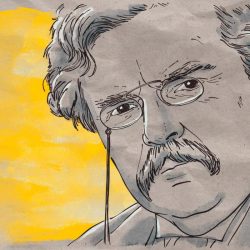
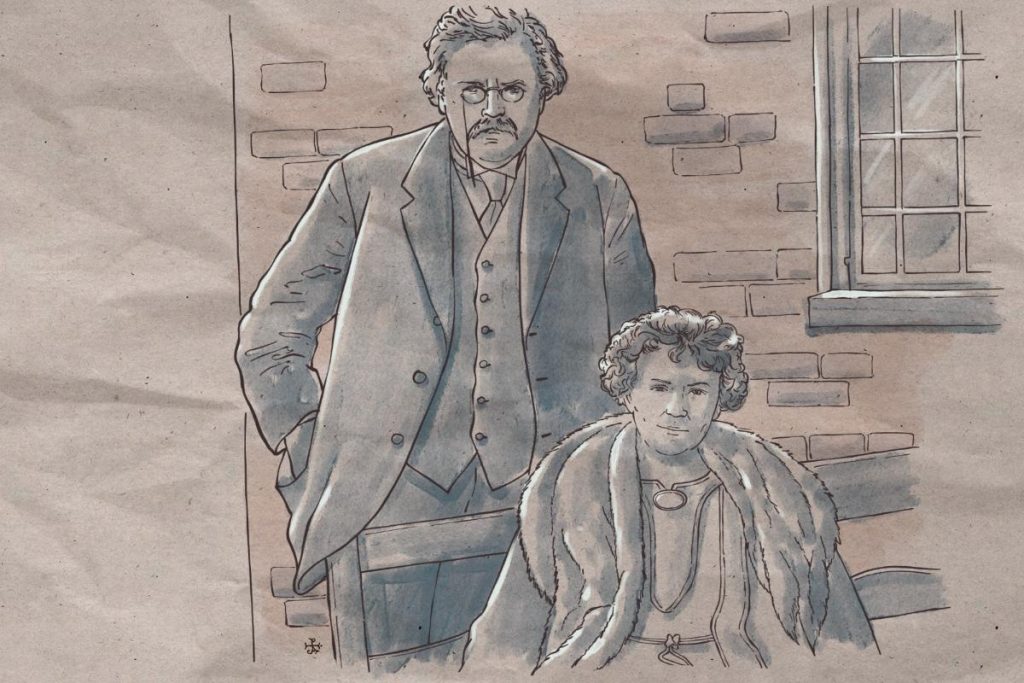
Gilbert Keith Chesterton is under consideration as a possible saint. He was a married man. We need to look at him within the context of his marriage, and see the importance of him as an example to us for today of what it means to found a family—even if natural accidents prevent the conception of children, as was his case—and to live a lay Christian life as the head of a household.

Marriage today is under attack. There is a loss of respect for the sacrament of matrimony. The definition of marriage as a lifelong commitment of two people of the opposite sex based on a vow they make to each other before God and their family and friends is no longer idealized in our society. Even the dictionary reflects a trendy modification of the definition of marriage.

Marriage is the one thing that can save our society, according to Chesterton, if we regard it as an institution and a sacrament, and not as a mere word, as it is treated in Hollywood and Washington. Chesterton believed in the traditional definition of marriage, meaning the foundation of a family. The family is the basic unit of society, the building block of a community. Strong families make strong communities, and strengthen the nation. What can we do to encourage and evangelize our families and communities so that we strengthen our weakened society?

We need to look more closely at Chesterton and his wife, Frances; we need to look more carefully at their marriage. Could the marriage of Gilbert and Frances be the example our society needs today, to reverse the trends determined to destroy the family?

Our parents and ancestors all made vows. Chesterton states that the votes of our ancestors constitute the democracy of the dead. Our ancestors voted for life with their lives. After all, here we are, living examples of their marriages and families. The history of all human society shows us that people form families and those families launch the next generation, and so on. Today’s society is hell bent on fracturing families, repeating the mantra that divorce is the answer, that one’s personal happiness comes before all else, and that the kids are OK. But the broken pieces cannot and will not make up a strong society.

A marriage vow is a vocation for life. We do believe in the fall of man, and therefore know that divorce is a reality. But the ideal is still a lifelong happy marriage. And the ideal, says Chesterton, will make society healthy. For where there is marriage and the foundation of a family, there is a healthier world.

Our society loves freedom—the freedom to break vows and commitments. But this is not true freedom; it is tyranny. The hearts surviving after a divorce, separation or even annulment are living brokenness, not wholeness. How do we restore the ideal? We keep believing in the ideal of happy marriage, and we keep our own vows. We know that we will have good times and bad. It will not be easy, but nothing worth doing ever is. We may have failed in the past, but we can renew our commitment to our vow today.

The example of Gilbert and Frances Chesterton tells us that true devotion to each other for life brings happiness and strengthens the world around us. A strong marriage affects our friends, our families, and our communities. When Gilbert became engaged, he wrote to Frances that he longed for even the Siberians and the Tasmanians to know about his engagement—and be glad. He wanted the whole world to rejoice because of their new commitment to each other.

Chesterton reminds us that our marriages do bring happiness to the whole world. And when marriages break down, they bring sorrow to the whole world. So we need to uphold the ideal, and try to live as Gilbert and Frances did. But how do we do that?

First, we might do well to review our wedding vows. The vows we made and promised to keep for a lifetime, till death do we part. We promised to be true, meaning our spouse would be the only one we give our love to. In good times and in bad means when things get rough—and they will—it will not be an excuse to divorce. We know ahead of time there will be both good and bad times, and we plan to stay through the bad times—barring abuse of course. In sickness and in health: most spouses are prepared at least to some degree to take care of a physical illness, but balk at the idea of staying with someone through a mental illness. In marriage, there is no distinction. We stay.

I will love you and honor you all the days of my life. It is not easy to keep vows. But when we make a promise, we have to think about the seriousness of what we are doing. If we have made a prenuptial agreement, we have prepared ourselves for divorce. And if divorce is a future option, the promises and the vows are made without the lifelong commitment in mind, and they are not true-hearted. Breakable vows cannot honor a person all the days of one’s life.

Marriage is the union of two incompatible people, and the whole object of marriage is to fight through and survive the incompatibility, says Chesterton. He also said marriage is a duel to the death which no man of honor should decline. And love means loving the unlovable, according to Chesterton. And at times our spouse will be unlovable, but that is when love finds it true meaning. Because truth be told, there will be times when we are unlovable, too. If we love only when it is easy, anyone can do that, said Jesus, even tax collectors. It is when love is hard that it becomes a virtue. And that is how we Christians, we Chestertonians, must love.

You may know of an unhappy marriage. You may be in an unhappy marriage. You may have just been invited to the second or third marriage of a friend. Your best friends may have just told you they are getting divorced. Broken marriages and separated spouses have become the norm in our society. But that is a norm we must fight with everything we have. Marriage is too important to let Hollywood or Washington or Santiago decide what it is and how it works. We must be the true hearts, the heirs of Gilbert and Frances Chesterton. We must keep our vows for life, and help others do the same.

There is an answer to the marriage crisis and that is prayer. And who better to pray to than a faithfully married couple? What if Gilbert and Frances together were a pair of heavenly helpers whom we could go to when our friends’ marriages are in trouble? Together, Gilbert and Frances provide us with an excellent example of a faithful, true-hearted marriage.

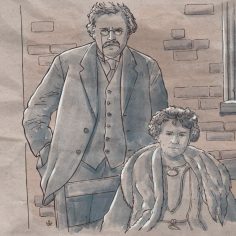
Gilbert and Frances Chesterton married in 1901 expecting to raise a large family. Frances told a friend she had wanted seven beautiful babies. Unexpectedly, they discovered after eight years and three operations, that they were infertile.

Infertility is a stress and certainly one of the “bad times” spoken of during that wedding vow. We may know spouses who have divorced because of it, spouses who have become bitter or resentful because of it. Some spouses have become depressed or worse because of it. But not Gilbert and Frances.

Gilbert and Frances accepted the unexpected burden of infertility by welcoming all friends’, neighbors’ and relatives’ children into their home. They discussed adoption, but eventually decided that instead they would treat each child that came into their home as a welcomed guest. They played games, made up toy theater productions, designing costumes and props. Frances served tea and cookies, and had sleepovers, some lasting weeks, months and in one case years. When Frances’s cousin’s husband deserted the family, Gilbert and Frances took on the role of godparents. They let the boys come over whenever they wanted, they paid for their education, and they showered them with love.

The Chestertons would become godparents to at least twenty-five young people. They truly were a good aunt and uncle.

Because Gilbert and Frances celebrated thirty-five years of married life together, and because they always appeared happy together, one could assume they never had any bad times or sickness, that they never suffered. This could not be farther from the truth.

Example One: When they first married, the Chestertons were quite poor. Gilbert was only just beginning his career, and was not yet the popular writer he would become. Frances married him believing he would be a famous poet, and that they would have a quiet life together devoted to poetry and family.

Example Two: Frances was ill most of her life. One of her legs was longer than the other, and she limped. She had other health problems, too, and was frequently in bed feeling weak and in pain. Gilbert, despite his reputation for robust eating and drinking, was also unhealthy and frequently ill. They took turns nursing each other through illnesses, accidents, and operations. Frances had operations for infertility, besides contracting the flu, which turned into pneumonia. Her appendix inflamed, and she had it removed. Gilbert broke his wrist, sprained his ankle, and had numerous oral surgeries. He collapsed and nearly died in 1915, from a heart and liver complaint that left him weakened. He was ill from Christmas till Easter that year. Frances nursed him back to health.

And despite his reputation as a “Jolly Journalist” Gilbert received plenty of criticism. Not everyone loved him or his writing. His reviewers sometimes complained of his wordiness, his overuse of paradox, or grumbled that his religious beliefs over-influenced him. His cheerful demeanor is evidence of fortitude and patience in the face of adversity.

Marriage is a vocation, and our spouse is our path to salvation. Gilbert and Frances chose each other, whether consciously or not, because they saw in the other a better half. Each brought gifts to the marriage, and each helped the other in what they lacked. Frances was a devout Anglo-Catholic when she met Gilbert—a theist with no formal religious affiliation. By the time they were engaged, Gilbert was a Christian—Frances had influenced him. He would dedicate his epic, Ballad of the White Horse, to her with the words, “To you, who brought the cross to me.” Twenty years later, Gilbert converted to Roman Catholicism, and influenced her. She converted four years later.

Hand in hand, Gilbert and Frances took on life together. Their faith was important, and they never stopped discussing God. They both cultivated gratitude, and were thankful for each other and for their marriage. They were both humble. Frances was so humble, she asked Gilbert not to write about her in his autobiography. As a result, her life has been a mystery until now. They cultivated childlike innocence. They remained open to romance and adventure, and they kept a sense of wonder. These things kept their marriage fresh and young, and helped them through the sickness and suffering.

Gilbert and Frances had a joyful, true-hearted marriage. They provide us with an excellent example of a faith-filled tightly woven marriage. Frances is a good example to women but no one knows because she lived such a quiet life compared to Gilbert. But they worked as a team, and their marriage was exemplary, so the two of them together are even more powerful as heavenly helpers than either one of them alone. I believe they provide help to married couples who call upon them, even now. This could be the answer to the marriage crisis; this could be the answer to those that seek to redefine marriage. This can be the answer to our friends and family members whose marriages are in serious trouble.

Right now, Gilbert and Frances are not yet officially saints. They were both good and faithful servants of Christ and lived virtuous lives. Because they are not officially saints, they are not that busy. If you know of a hopeless marriage, this is the perfect time to call upon Gilbert and Frances Chesterton. Hope finds its meaning, says Chesterton, when things seem hopeless. Call upon them with confidence, in particular if the situation seems hopeless.

Be imitators of Gilbert and Frances, as they were imitators of Christ. Become friends with them in heaven, and ask them for help for the marriages you know that are in trouble right now. If we save one marriage, we strengthen all of society.

Autor: Nancy Carpentier

Author of The Woman Who Was Chesterton, the first biography devoted to Frances Blogg,
wife of G.K. Chesterton, and co-founder of the Frances Chesterton Rosary League.

Síguenos:
(Visited 10 times, 10 visits today)

Comments are closed.