chesterton necesario hoy

by

The prophetic wisdom of G.K. Chesterton for a broken and backwards world

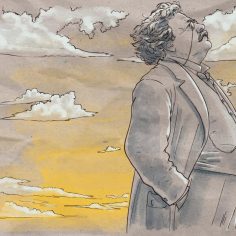
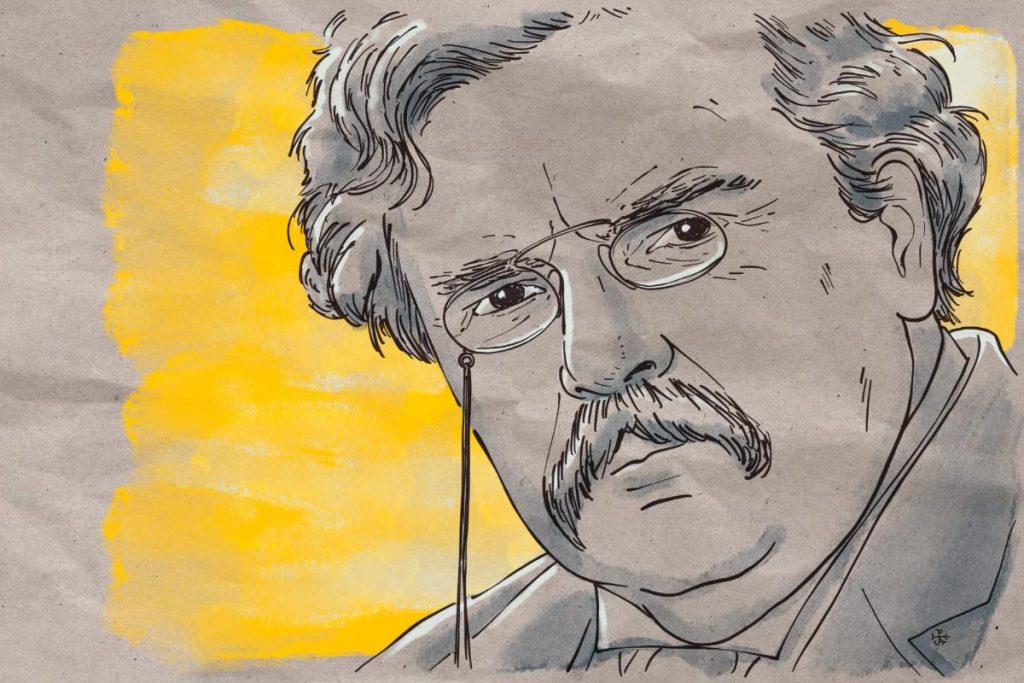
He was one of the most well-known and most beloved writers of the early 20th century, whose writings profoundly affected a wide range of leading figures from Gandhi to Michael Collins to C.S. Lewis to Fulton Sheen to Agatha Christie. He was a huge and happy and humble man, clad in a cape and floppy hat, who, when told by a young woman on the streets of London, “Everyone seems to know you Mr. Chesterton!” replied with a sigh, “If they don’t, they ask.”

But no one seems to know who G.K. Chesterton is anymore. And they don’t even ask. He should be taught in our schools, but his powerful and provocative books are utterly neglected.

And yet, if the definition of a classic is something that is quoted but never read, then G.K. Chesterton certainly qualifies as a classic. In spite of the fact that he is forgotten, his words are remembered. You see his wise and witty sayings everywhere:

“The Christian ideal has not been tried and found wanting, it has been found difficult and left untried.”

“There will be more, not less, respect for human rights if they can be treated as divine rights.”

“A citizen can hardly distinguish between a tax and a fine, except that the fine is generally much lighter.”

“If a thing is worth doing, it is worth doing badly.”

“Take away the supernatural, and what remains is the unnatural.”

“Angels fly because they take themselves lightly.”

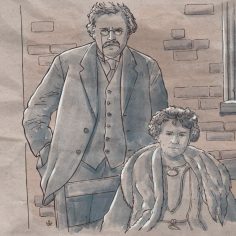
Gilbert Keith Chesterton died 90 years ago, on June 14, 1936. He was born May 29, 1874. He was one of the most prolific writers who ever lived. In addition to the 100 books he wrote, the poetry, the detective stories (the Father Brown mysteries), and the novels, he penned thousands of essays for newspapers and magazines in England and America. There is simply too much here to be ignored. A giant can only remain hidden for so long. In spite of his disappearance from the curriculum, he is slowly being rediscovered outside of the academy by a new generation. What these new readers are finding is something they do not expect: a writer who seems to be writing more for our day than his own.

There is an unconscious prophetic quality to Chesterton’s writing. He pointed out all the things in our world that attack the family and attack the faith. He warned of the dangers of both big government and big business, which would rob the family of its rights and its independence and its integrity. Wage slavery pulls both fathers and mothers out of the home. Public education and Day Care pull children out of the home. They are not raised by their parents, but by a strange collusion of public and private enterprises. Chesterton said the obvious effect of frivolous divorce would be frivolous marriage. He warned that the next great heresy would be an attack on morality, especially sexual morality. He predicted that the acceptance of birth control would lead to the acceptance of abortion and then infanticide. He said public education would be a failure because if education is emptied of religion, students will be only half-educated, and in effect, literally half-witted. And because of the failure of the public schools, he said that children would constantly be subjected to new educational experiments, controlled by the few, unaccountable to anyone, especially parents, and the student would continually be taught by new educational philosophies “younger than himself.” He said the greatest problem would be “standardisation by a low standard.”

Chesterton accurately predicted such monumental events as the rise and fall of Soviet communism, the outbreak of violence against the Jews in Europe, the beginning of World War II on the Polish border, the rise to dominance of the media, the entertainment industry, and even professional sports.

When a writer gets so many things so astoundingly right, it might be worth taking another look at him. He has proved himself trustworthy.

Chesterton had an uncanny ability to see the big picture. He said that in a broken society, two things happen: the vices run wild and do great damage, but the virtues also run wild and do perhaps even greater damage “because they are isolated from each other and wandering alone.” Thus, there will be some who care only for truth and others who care only for pity. But those on the one side, “their truth is pitiless,” and those on the other side, “their pity is untruthful.” It is hard to imagine a more concise analysis than that of the dichotomy between the conservatives and the liberals. Conservatives, in insisting on correct doctrine and theology, have often neglected compassion and social justice, which gives a lie to their theology. Liberals have done just the opposite: in emphasizing social justice without the right theology, they are now defending wrongs instead of rights.

Truth and love must always go hand-in-hand, just as the two great commandments must always be remembered together: we must love God with all our being, and love our neighbor as ourselves.

We live in a broken society. Everything is broken and backwards. Our values are mixed up. All the brokenness can be traced to breaking these two commandments. Chesterton said, “When you break the big laws, you do not get freedom; you do not even get anarchy. You get the small laws.”

Chesterton was trying to fix our broken society. He pointed out the fallacy of the cult of “progress,” that is, of simply moving forward when we have no idea where we’re going. We cannot have progress unless we have defined our goal, and then we can determine whether we are moving closer to it or farther from it. If we get off track, even slightly off track, we will get farther from our goal the more we keep moving on the wrong track. That is not progress. Instead, we need to turn around and go backwards in order to get back to the point where we went wrong. Chesterton was always trying to get us to go back to first principles, to start right rather than continuing wrong. Chesterton was an “original,” in that he was trying to get us to think about the origins of things. He defined culture as, “the healthy growing of ideas from their own original seed: and if you don’t like that, you don’t like civilization. Also, it does not like you.”

People sometimes say to me, “We need another Chesterton.” But we don’t. The one we have been given is quite sufficient. His words are readily available to us. They are as timely as ever. He has not gone away. The only problem is that we have ignored him at our peril.

Autor: Dale Ahlquist

President and co-founder of the American Chesterton Society
and editor of its magazine, Gilbert.

Síguenos:
(Visited 26 times, 26 visits today)

Comments are closed.